
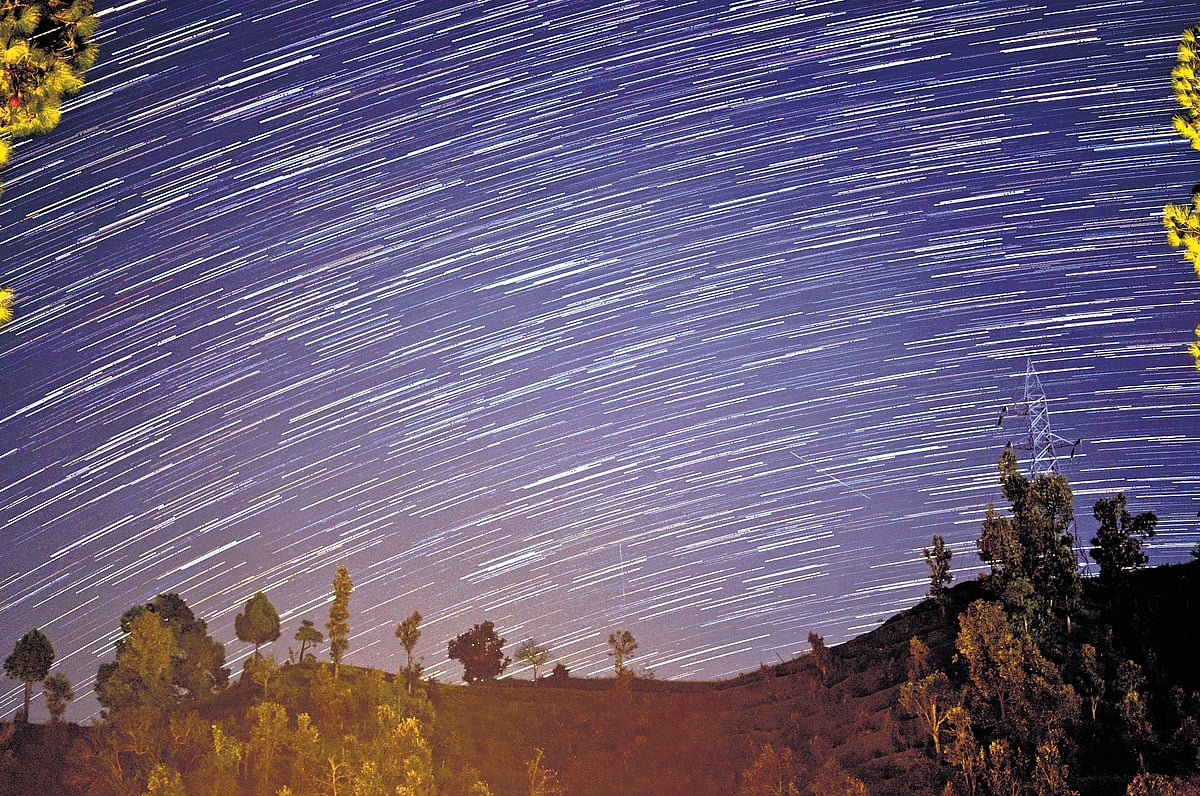
It is just 7 pm but feels like midnight. That’s how dark it is at Nakshatra Mahasabha, an astronomy and stargazing camping site, seven kilometres away from Jageshwar in Almora, Uttarakhand. The participants are mainly from the city, aged seven to 70. They are pleasantly surprised to see a sky full of stars that early in the evening, which is not something they see at home. “I have never seen so many stars in my life,” someone exclaims.
Just then Ramashish Ray, founder of Starscapes, co-organiser of the camp along with Uttarakhand Tourism, announces, “Lights off.” One after one, all the lights of the camp are turned off. The participants switch off their mobile phones. It becomes pitch dark all around. For a couple of minutes, nothing can be seen. But like Ray had said, eyes adapt to star light and gradually myriad tiny, twinkling silver dots appear in the night sky.
Astronomy camps are usually set up in places with minimal light pollution, so that stars are visible clearly. Jageshwar, a valley town surrounded by the Himalayas and covered with tall, deodar trees is one such place. From here, on this night even International Space Station (ISS) hurtling along on its usual ellipse is spotted for a few seconds, eliciting excited squeals and applause from participants.
Heads still up. There is the North Star or the Polaris, rising above the deodar trees. There is the Big Dipper, a star pattern of seven bright stars, which tells star gazers which among the thousand stars in the sky is Polaris.
Draw an imaginary line between the two outermost stars of the bowl of the Big Dipper called Dubhe and Merak; extend that line about five times the distance between the two stars and one arrives at Polaris, positioned almost directly above the Earth’s northern rotational axis, making it a reliable indicator of the north. In a bygone world without GPS, sailors and travellers relied on Polaris and the Big Dipper to learn the direction they were heading to.
Talking of directions, to the east of Polaris, Saturn is rising swiftly. Camp volunteers urge people to assemble by the specialised, high-intensity telescopes at the camp to get a closer look at the planet. It’s mesmerising to see the giant, yellow ball sporting shades of orange and brown, splendid rings, and 146 moons. Its largest moon, Titan, is visible through the telescope.


